Adding hyperlinks to print publications

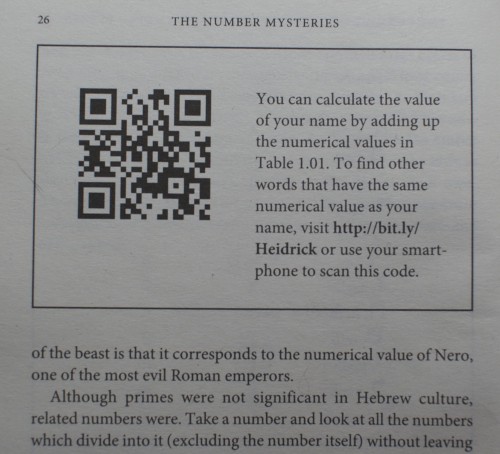
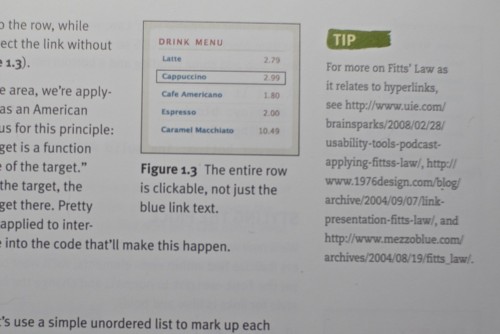
I am very impressed with how Marcus du Sautoy’s The Number Mysteries integrates hyperlinks into the book using URL shorteners and QR codes (above). Contrast that with Dan Cederholm’s Handcrafted CSS _(which is still an excellent book). _The latter was published August 2009, the former August 2010.

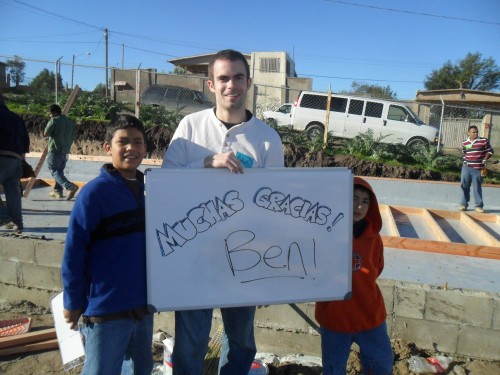
De nada, Una Pequeña Casa

My former-roommate Alex (the guy in the middle) is spending his winter vacation in Mexico volunteering with One Small House. I donated to the project and they’ve been awesome in thanking me. > During the week of December 26-31, 2010, a group of volunteers from the United States will work with the community of Lazaro Cardenas to build them a new, free health clinic. Currently, this small community is receiving its health services from a trailer that is inadequate to handle their needs. With the support of donations, One Small House and its volunteers will help ensure that this community receives the quality health care it needs.

T Shirt

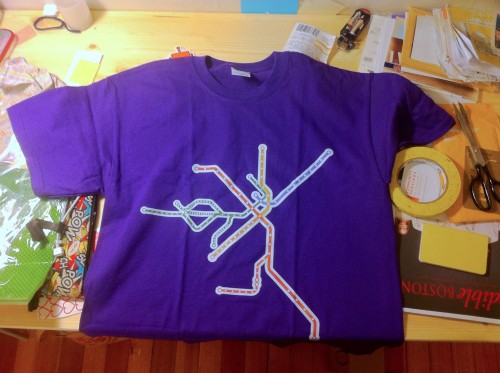
An Island 94 commenter requested a t-shirt based on the Boston Subway Map I vectorized a while ago. So I set up an at-cost shop through Spreadshirt, and ordered one myself.

Mediation journal pieces

This is a set of images from a self-journaling project I’m working on based around my media-consumption habits. A few months ago I designed a self-journaling worksheet for Angelina, and she really liked the use of a blank face for the critical-reflection process—so that’s one part of it. I just sent off Version 0 to be printed; I’ll post some photos when it arrives.

Boston Bike Crash Map in the News

Boston’s Metro newspaper ran a page 2 article on the Boston Bike Crash Map the Boston Cyclists Union and I created. Also in the news:

This is a stunning example of what a non-profit can do with government statistics, Google Maps, and a very dedicated volunteer.

Among other concentrations, it shows a dark line of bruised elbows, broken fenders, and worse stretching from the Back Bay to Allston along Commonwealth Avenue, right past our studios at WBUR.

Proposals to change the tax-deductibility of donations

The New York Times yesterday gave a breakdown of proposals to change how donors calculate donations in their taxes:

All three deficit reduction proposals from the blue ribbon panels would eliminate the deduction in its current form.

One of the panels, the National Commission on Fiscal Responsibility and Reform would give taxpayers a tax credit worth 12 percent of their donations — but only if they contributed 2 percent or more of their adjusted gross income to charity.

Another plan proposed by a panel of three liberal-leaning organizations — Demos, the Economic Policy Institute and the Century Foundation — is similar, suggesting a 25 percent tax credit for all charitable gifts.

The plan philanthropic experts find the most intriguing, however, comes from the Bipartisan Policy Center panel, which suggests borrowing a system of subsidizing nonprofits similar to the one used in Britain, called Gift Aid.

Under that proposal, nonprofits could claim a tax credit worth 15 percent of any charitable gift they received, effectively giving the donor a partial match. For instance, if a donor makes a charitable gift of $100 to a charity, the charity could apply to receive an additional $15 from the government.

I’m partial to this proposal from the Partnership for Philanthropic Planning (via Gift Hub):

For many years, PPP has suggested a conceptual alternative to the charitable deduction. PPP’s plan addresses the current goal of simplifying the tax code, while supporting a robust nonprofit sector that can compensate for reduced government services. Rather than a deduction from income, we propose that charitable contributions be treated as an adjustment from gross income. Since the donor never receives the benefit of income which is contributed to charity, the amount contributed should be considered unavailable for taxation at all. Far from the “tax expenditure” that the [National Commission on Fiscal Responsibility and Reform] suggests, allowing charitable contributions as adjustments to income would provide a fair and accessible incentive for charitable giving to all Americans.

And of course, don’t forget the background context of rising inequity, a lapsed estate tax, and the models of individually-determined giving versus democratically-determined (ostensibly) government grants and earmarks.
Blue Ribbon Commissions in Print

I was annoyed by my previous post quoting the New York Times’ usage of “blue ribbon panel” (and the numerous appeals to authority in that entire article) that I looked it up using Google Search’s timeline: site:nytimes.com [“blue ribbon panel” OR “blue ribbon commission”]. There were 621 results.

Undermining nonprofit significance

From a Facebook comment on Kate Barr’s “ Nonprofits, Social Enterprise, and Hot Buttons” ( blog link):

The craving to undermine nonprofit signficance, value and tax-exemption is endless and will probably never be “satisified” until the entire 501-c section of the tax code is repealed. And there do exist those who want to do exactly that. Those who deeply resent paying taxes at all loathe the nonprofit field for its tax exemption. They won’t stop and they won’t shut up, even when repeatedly, humiliatingly and thoroughly refuted.

This is a perspective I share, though rarely so explicitly.

This is me not being cynical about nonprofit innovation

A comment I made about the newly launched Jumo platform for nonprofits, in response to much bellyaching on Facebook about it being duplicative and pointless:

I don’t get it either. But I’ve been increasingly thinking about a recent David Pogue column ( http://nyti.ms/id0kep) in which he says “Things don’t replace things; they just splinter.”

We have this idea in the nonprofit world that we must overly optimize the resources we have; cleanly transitioning from one model to the next with minimal duplication. That’s not realistic and probably wouldn’t be innovative either. Instead we just have this messy iterative process of broken models, half-starts and ignorant foundation officers—from which the next round of innovators can cobble together an itch-scratcher and pitch it as “Hotness-XYZ but for nonprofits”.

I think Jumo sucks so far, but the few million dollars it took to launch is a drop in the bucket. Unless it causes Omidyar and Knight to pick up their checkbooks and go home, I think it will help move the ball towards something more transformational to the sector.

Public data vs. Self-reporting

A comment by Pete Stidman of the Boston Cyclists Union, in response to a proposal to build a Chicago Bike Crash Map:

I would advise against self reporting—because what you get is only crashes within whatever bike subculture is reached by the map and by the web. Boston did that before our map and the spread of accidents across the city is very different in each—and could give people the wrong ideas about priority streets and areas. (This is particularly true in communities of color, which were heavily under-reported in Boston’s self-reported crash survey.)

Boston’s bike crash map is generated from (somewhat-) public data on on ambulance runs and EMT reports; Portland has a self-reported bike incident map.


Newer posts Older posts