Thesuarus computations
Thoughts.
Thesuarus computations
Thoughts.
Thesaurus computations
Today I just started computing the relations between groups. It’s been chugging along on my local machine for about 8 hours now, I’m 1% complete and have a table with 5 million entries (at 210mb).
If a word is shared between two groups, it forms an edge between those two groups. I’m storing that edge as the two group ids and the “overlap” value (the number of words shared between those two groups).
My algorithm is iterating through every word, finding the groups that the word is a part of, and creating an edge between them—computing overlap as it goes. I expect the rate to fall off as duplicate edges are thrown out…. but we’ll see.
Tee
tee is a Unix command that displays the output of a program and copies it into a file.
lint program.c | tee program.lint
Pasta dough recipe
1 cup flour (I’ve been using white whole wheat)
1 egg
~2tbps cool water
Mix flour and egg, adding water until flour is just moistened and sticks together
Let rest for 5 minutes
Knead the dough for 2 minutes. Or you can do it for 10 minutes; more kneading means better developed gluten and a “smoother” noodle.
Let rest 10 minutes
Roll out or whatever
(adapted from a cooks.com recipe
Hemp milk
Info on Hemp Milk.
I just bought some of this (Manitoba Harvest brand, the chocolate kind) at Whole Foods. It’s not soy milk, but I’m not sure if it’s any better. I kind’ve got a bit of a choke in the back of my throat on the first sip, though after that it was pretty smooth.
Fears of death
Thoughts of mortality make people entrench their beliefs. (via boingboing). It also makes people act in ways that boost their self-esteem, which, importantly, affects their consumer behavior (via google).
These seem to both be domestic studies. I wonder how the US compares internationally in “mortality awareness”. (I’m guessing pretty low).
Verb to do
A great list of functional verbs for writing resumes or their reverse situational equivalent: job descriptions. (via Google)
ADMINISTRATIVE ACTION VERBS
| advise | Offer an informed opinion or give specialized information to others. |
| adapt | Modify or change to fit specific or new situations. |
| administer | Manage or direct. (Generally requires some additional explanation to show specific detail.) See manage. |
| appoint | To set officially, arrange. |
| approve | Exercise final and decisive authority, causing action to use money, manpower, materials, or equipment. |
| arrange | To make preparations for, to plan. |
| authorize | Approve or commit an act implying subsequent action by others. |
| consult | Consider, asking advice or requesting opinion of. |
| control | Direct, regulate, or guide the use of money, methods, equipment, and materials. Also, the process of monitoring activities to ensure conformance with planned results. |
| coordinate | Regulate, adjust or direct the related actions of others in order to attain desired results. |
| decide | To select a course of action. |
| delegate | Entrust to another person tasks or duties which require exercise of some of the authority of the person originally responsible, as “To delegate an administrative assistant to represent the department at conferences.” |
| determine | To fix conclusively, regulate. To decide by choice of alternatives. |
| direct | Govern or control work operations by establishing the implementing objectives, practices and methods. |
| enforce | To effect or gain by force. To carry out effectively. |
| establish | To institute permanently by enactment or agreement. |
| execute | Put into effect or carry out methods, plans, etc. |
| initiate | Set going or introduce. |
| manage | Plan, organize, direct, control, and evaluate operation of an organizational unit, with responsibility for the output. |
| order | Arrange or command to come to a specified place or decision. |
| organize | To set up an administrative structure for. To arrange by systematic planning and united effort. |
| plan | To design or plot a scheme or project by means or method devised for doing something to achieve an end. |
| reject | To refuse to accept, consider or submit to. |
| require | To ask for by right and authority, request. |
| review | Consider or examine facts or results for accuracy, completeness and suitability. |
| supervise | Personally oversee or control work performance and conduct of others, where there is opportunity for control or inspection of work performed. |
| train | Teach, demonstrate, or guide others in the performance of assigned work. |
PUSH ALONG VERBS
| activate | Set up or formally introduce with necessary personnel or equipment. |
| encourage | Give help, inspire or pay patronage to. |
| expediate | Accelerate the process or progress of a plan, idea. |
| further | Promote or advance. |
| implement | Carry out or fulfill by taking action. |
| maintain | Keep in satisfactory condition. |
| motivate | Provide incentive or drive. |
STOP VERBS
| check | To proof or review for errors. |
| delete | Eliminate or wipe out. |
| prevent | Keep from happening or holding back. |
| return | Go back in thought or action. Give an official account to a superior. |
| stop | Keep from carrying out a proposed action. |
HELPER VERBS
| advise | Offer an informed opinion or give specialized information to others. |
| aid | Provide with what is useful or necessary for achieving an end. |
| cooperate | Act jointly with others. Act or work with others to obtain a mutual benefit. |
| counsel | Advise or consult. |
| explain | Make plain or understandable. |
| guide | Direct, supervise, influence or superintend the training of people. |
| instruct | Teach, demonstrate, or by other methods impart knowledge to others. Direct that a specific activity be performed, may include directing how it is to be performed. |
| participate | To take part or have a share in a project, group. |
| protect | Maintain status or integrity of project, idea. |
| serve | Comply with the commands and demands of a boss, group. |
| show | Propose or mention an idea as workable or desirable. |
| suggest | ? |
GET & GIVE VERBS
| accept | Give admittance or approval to. |
| accumulate | Increase gradually in quantity or number. |
| acquire | Come into possession or control of an item or items. |
| arrange for | To make preparations for, to plan. |
| buy | Acquire possession, ownership or rights to the use of services, items. |
| collect | Gather or exact information or materials from a number of persons or sources. |
| compile | Put together information or assemble data in a new form. |
| deliver | Send or bring a desired object. |
| distribute | Deliver or hand out to several or many. |
| exchange | Give and receive reciprocally. |
| forward | Send goods or information onward. |
| furnish | Provide or equip with what is needed. |
| gather | Bring together or collect parts of a group. |
| get | Obtain or receive. |
| give | Grant or yield to another. |
| inform | Communicate knowledge to others. |
| inquire | Ask or search into. |
| issue | Make available through distribution. |
| keep | Preserve or maintain in a good and orderly condition. |
| To send by the postal service. | |
| notify | Give notice or a report on an occurrence or information. |
| obtain | Gain or possess. |
| pick up | ? |
| procure | Get possession or obtain by particular care and effort. |
| provide | To supply support to meet a need, make available. |
| pull | Demand or obtain advantage by use of exertion or influence. |
| purchase | Gain or acquire by labor, money. |
| recall | Call back or cancel. |
| receive | Come into possession of or acquire an item, idea. |
| recruit | Increase numbers of a group or bring in new members. |
| render | Deliver or hand down. |
| report | Give an account or make a written summary or statement. |
| secure | Put beyond hazard or receive lasting control. |
| sell | Give up property in exchange for money. |
| send | Deliver or dispatch as means of communication or delivery. |
| solicit | To make a petition or request for services, money. |
| submit | Yield or surrender to authority. |
| supply | Make materials available for use. |
| take | Get or seize into possession. |
| transfer | Pass over from one person to another. |
| withdraw | Back away or remove. |
CREATIVE VERBS
| create | Produce through imaginative skill. |
| design | Create or fashion a plan or idea. |
| develop | Disclose, discover, perfect, or unfold a plan or idea, in detail, gradually. Implies study and/or experiment unless otherwise stated. When used as “to develop subordinates”, see train. |
| devise | Form in the mind by combinations of ideas, new applications of principles, or new arrangement of parts. |
| establish | To institute permanently by enactment or agreement. |
| estimate | Forecast future quantities, values, sizes, extents, etc., either on the basis of judgment or calculations. Frequently, estimating is shared with others, in which case it is more precise to use “estimate” as a noun, and to state the job’s function in relation thereto, i.e., originates, analyzes, endorses, approves, etc., estimates of… |
| forecast | Predict future events based on specified assumptions. |
| formulate | Put into a systemized expression or statement. |
| iniyiate | Set going or introduce. |
| install | To set up for use. |
| originate | Begin or initiate. |
| plan | To design or plot a scheme or project by means or method devised for doing something to achieve an end. |
| project | Plan, figure, or estimate for the future. |
| schedule | Appoint a fixed time. |
APPRAISE/STUDY VERBS
| analyze | Identify the elements of a whole and critically examine and relate these component parts separately and/or in relation to the whole. |
| appraise | Judge as to quality; compare critically with established standards. |
| ascertain | Find out or learn with certainty. |
| check | To proof or review for errors. |
| compare | To examine characteristics to discover similarities or differences. |
| consider | To observe or think about with regard to taking some action. |
| criticize | To evaluate and judge merits or faults. |
| develop | Disclose, discover, perfect, or unfold a plan or idea, in detail, gradually. Implies study and/or experiment unless otherwise stated. When used as “to develop subordinates”, see train. |
| evaluate | Appraise, to determine value, condition, significance or worth. |
| examine | Investigate in order to determine progress, fitness or knowledge. |
| forecast | Predict future events based on specified assumptions. |
| identify | The act of proving identity. |
| inspect | Examine materials, equipment, reports, work, etc., to determine quality, suitability for use, etc. |
| interpret | Explain to others (orally or in writing) the meaning or significance of something. |
| interview | Obtain information through questioning. |
| investigate | Uncover facts by systematically finding them, conducting a search, and examining various sources. |
| measure | Control or regulate by a standard or in measured amounts. |
| plan | To design or plot a scheme or project by means or method devised for doing something to achieve an end. |
| rate | Estimate or determine the relative value, rank, or amount of an item. |
| research | Specific inquiry involving prolonged and critical investigation, having for its aim the study of new facts and their interpretation, the revision of accepted conclusions or theories that may be affected by newly discovered factors, or the practical application of such new or revised conclusions. Example: Technical research to develop new products for the company. |
| resolve | Deal with a problem, dilemma successfully. |
| review | Consider or examine facts or results for accuracy, completeness and suitability. |
| solve | Find a solution, answer, or explanation for a question or problem. |
| study | Apply thought to any subject of investigation in order to arrive at the most suitable conclusion. |
| summarize | To tell and reduce a story, idea. |
| survey | Examine a condition, situation or value. |
| test | Assign a value or evaluate an item by a given test. |
| weigh | Merit consideration as to importance. |
CONTROL VERBS
| allocate | Assign or apportion for a specific purpose or to a particular person. |
| audit | Perform a formal examination into a company’s formal accounts. |
| check | To proof or review for errors. |
| conserve | Slow or block the progress of something |
| control | Direct, regulate, or guide the use of money, methods, equipment, and materials. Also, the process of monitoring activities to ensure conformance with planned results. |
| edit | Alter, adapt or refine a written text, concept, or idea. |
| enforce | To effect or gain by force. To carry out effectively. |
| ensure | Make sure, certain, or safe. |
| guarantee | Undertake to answer for debt and default or promise security. |
| inspect | Examine materials, equipment, reports, work, etc., to determine quality, suitability for use, etc. |
| regulate | Fix or adjust the time, amount, degree, or rate. |
| restrict | Place under restriction as to use or distribution. |
| review | Consider or examine facts or results for accuracy, completeness and suitability. |
| verify | Confirm or substantiate by oath, law, or other documentation. |
Trustworthiness
Just saw this demo of an algorithm that rates the trustworthiness of Wikipedia articles. It computes the “trust” of authors by how long their edits stick around, then applies that to articles. (via Slashdot)
I wonder how it works on entries that are intentionally misleading, like the entry on Discordianism.
Unintuitive: check
CCK’s single checkboxes require a strange configuration in the Allowed Values list:
0
1 Checkbox title
More thoughts on an interesting thesaurus
My associate, Rebecca, and I have been starting to think critically about Panlexicon.com, the unique, tag-cloud based thesaurus I’ve written about previously. We’re hoping to put some more time and effort into the project and in the process, learn some more about what’s happening with the language and the underlying structure of the thesaurus taxonomy.
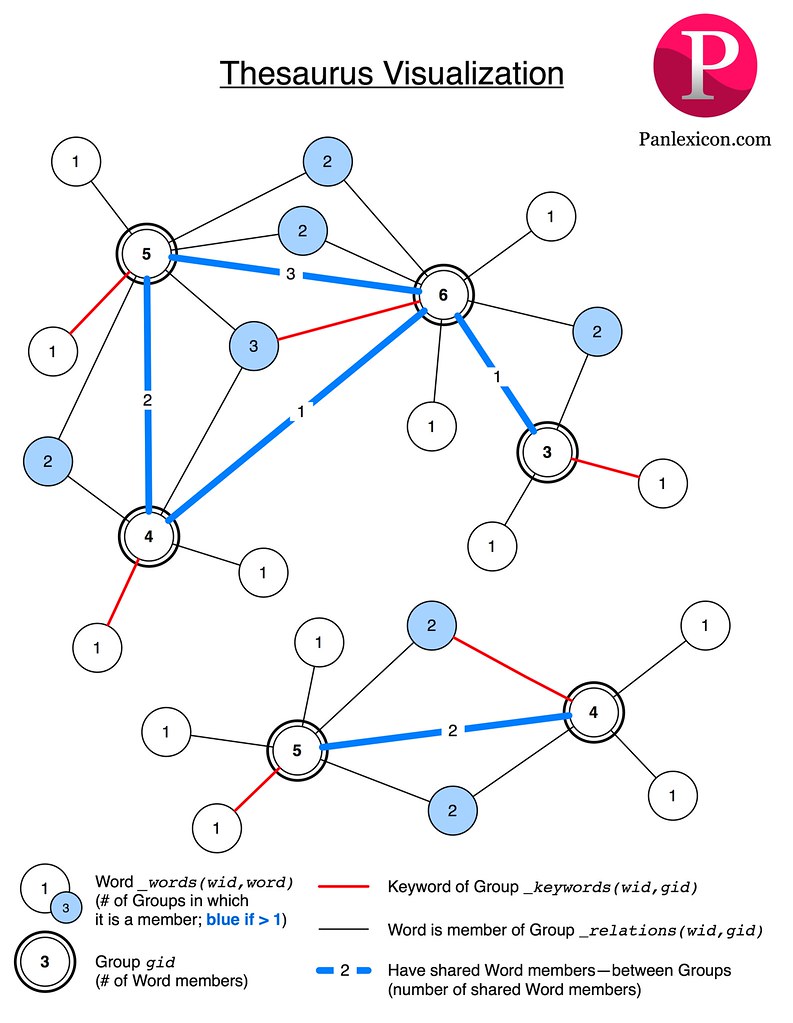
The thesaurus data we’re working with is the Moby Thesaurus from the Project Gutenburg library of free electronic texts. Like many thesauruses, it’s structure in an interesting way. Every word is assigned to one or more groups based on it’s general meaning or idea. Each group has a keyword, also known as a headword, that is a general encapsulation that idea—this is why, for example in Roget’s, you must first look up a word in the index to acquire its keywords. Each group has only one keyword, but a keyword can exist in other groups (but as an ordinary word).
This thesaurus structure allows us to do some easy simplifications and analysis on the data. For many functions, we can treat the groups as supernodes, performing operations and storing connections upon them in place of the words themselves. For example, when determining relatedness between words, we only have compare the groups they are a part of; while there are approximately 100,000 words in our database, there are only 30,000 groups, which greatly diminishes the size and complexity of the data set we’re working on.
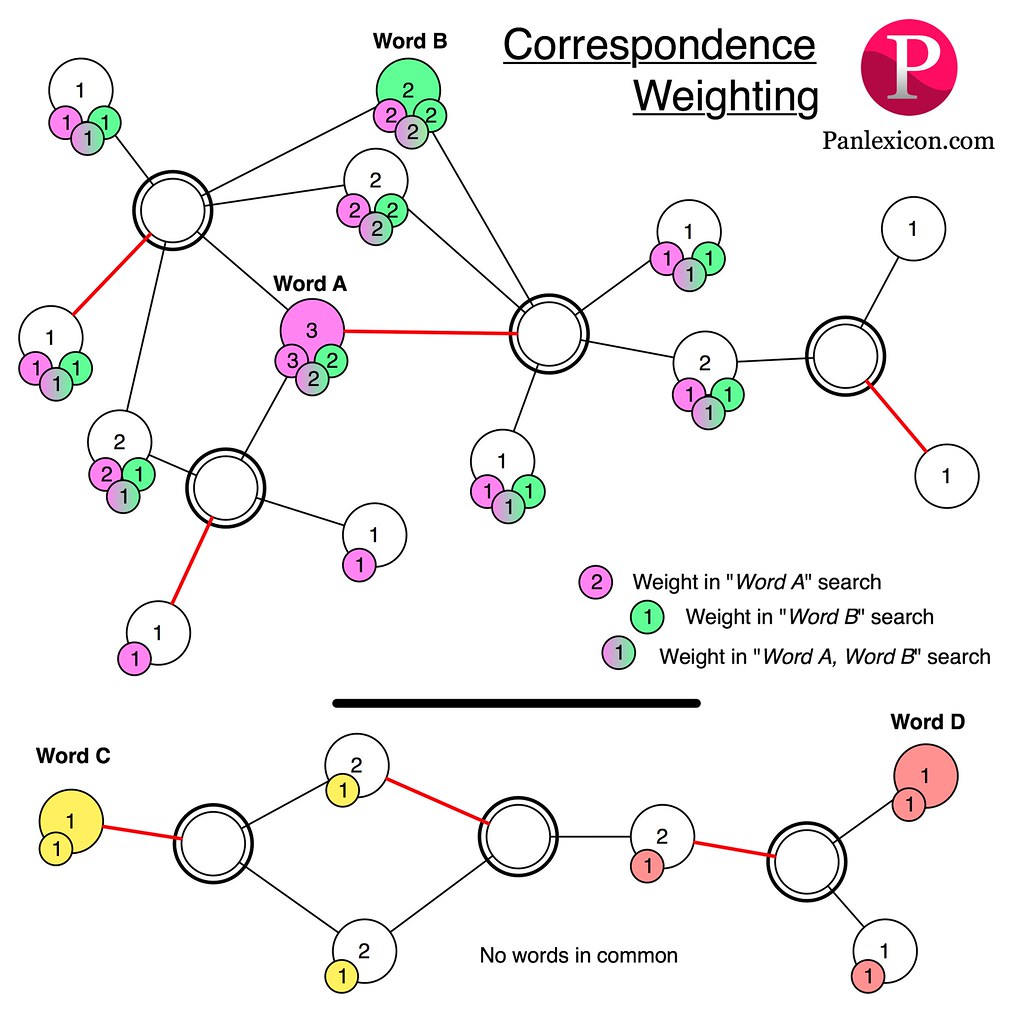
Currently Panlexicon works by comparing the overlap between groups of words. When typing in a search term, Panlexicon looks up all of the groups that word is a member of. It then returns a list of words that are also in those groups. The weight of each word (or size in our word cloud model) is calculated according to how many groups—-of those groups that include the search term—that word is a member of. A property of this is that no other returned word will have a heavier weight than the search term. When searching multiple terms, Panlexicon creates a set of groups such that all search terms are a member. In the case when there exists no groups that contain all the search terms, Panlexicon returns nothing.
Already we’re digging into some interesting relations that turn up in the thesaurus data. For example, one of my favorite linguistic myths is that Eskimos have 50 different words for snow. The supposed lesson was that eskimos had a different conception of snow than us (the non-Eskimos). I always wondered, “Well, is 50 a lot?” The largest group in our thesaurus has the keyword cut with 1448 related words or synonyms. This is followed by set (1152), turn (1108), run (1025), and color (1007). That’s quite a bit.
Also, interestingly in our dataset, are the most versatile words. These words are members of the most groups. The list shares four out five of the same words as those of the most synonyms, beginning with cut, being a member of 1120 distinct groups. This is followed by set (928), run (750), turn (715), and check (699).
Right now, we’re investigating paths between words. This will allow us to play the Kevin Bacon game, making connections between words that may not share the same group. It will be interesting to determine what words are connected (even through a medium) and which ones are disconnected. Lastly on our list of things to do is determine the eigenvectors of our groups in relation to how their connected to other groups. This will allow us to determine—without using fancy words like Markov chains—which words are probably used the most. I say probably because we’re analyzing a taxonomic work, rather than actual speech. Who knows if they match up; we’ll find out.
